| 1 |
Saturday, September 25, 2027 |
Remich, Luxembourg |
Embark |
5 pm |
Remich, in the SE part of Luxembourg, lies on the left bank of the Moselle River, which forms part of the border between Luxembourg and Germany. The Moselle valley is dominated by wine-making and many small wine-making towns, of which Remich is one of the most picturesque tourist town. Visitors enjoy touring the St Martin wine cellars which are situated at the northern edge of the town, hollowed out of the rock, and devoted to wine and champagne production. Read more about Remich, Luxembourg
|
| 2 |
Sunday, September 26, 2027 |
Remich, Luxembourg |
|
|
Remich, in the SE part of Luxembourg, lies on the left bank of the Moselle River, which forms part of the border between Luxembourg and Germany. The Moselle valley is dominated by wine-making and many small wine-making towns, of which Remich is one of the most picturesque tourist town. Visitors enjoy touring the St Martin wine cellars which are situated at the northern edge of the town, hollowed out of the rock, and devoted to wine and champagne production. Read more about Remich, Luxembourg
|
| 3 |
Monday, September 27, 2027 |
Bernkastel, Germany |
|
|

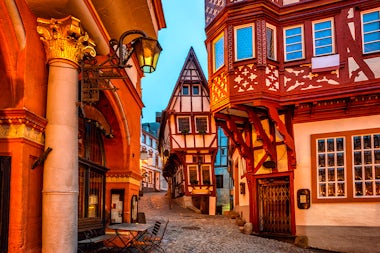
Bernkastel is a district of the town Bernkastel-Kues, a well-known wine growing centre that is over 700 years old, located on the Middle Moselle river in Rhineland, Germany. The town is a state-recognized health resort and the birthplace of one of the most famous medieval churchmen and philosophers, Nikolaus von Kues. His birthplace has been well preserved over the centuries. Read more about Bernkastel, Germany
|
| 4 |
Tuesday, September 28, 2027 |
Cochem, Germany |
|
|
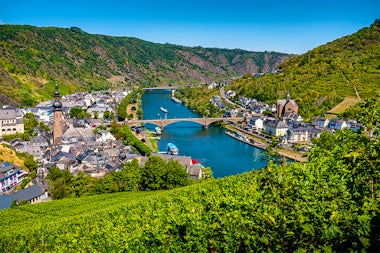
Cochem is a town on the west bank of the Mosel River and the capital of the district of Cochem-Zell, Western Germany. It is situated in the valley of the Mosel, surrounded by vineyards, and at the foot of a hill overlooked by the Reichsburg, a feudal castle that dates from 1051. The history of Cochem in Celtic, Roman, and early Middle Ages is unknown, but its location was ideal for farming and wine production with access to the Mosel river traders. Read more about Cochem, Germany
|
| 5 |
Wednesday, September 29, 2027 |
Rudesheim, Germany |
|
|
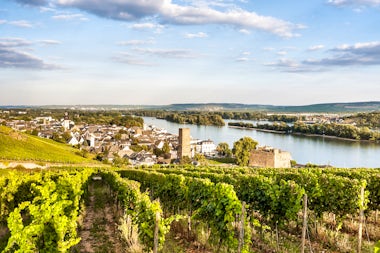
Rüdesheim lies in the heart of the Rhine River area at the southern entrance to the Lorelei valley. It is well known for the Drosselgasse, just 144m long, the pedestrian street at the heart of the city's old town. It is full of beautifully decorated restaurants, live band entertainment, and open air garden taverns that are always thoroughly enjoyed by visitors. Read more about Rudesheim, Germany
|
| 6 |
Thursday, September 30, 2027 |
Cologne, Germany |
|
|
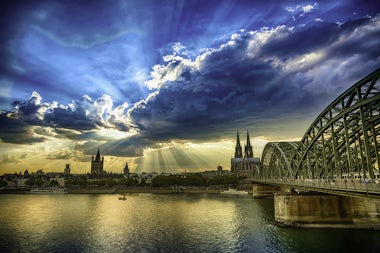
Cologne, situated on the River Rhine and Germany’s fourth largest city, was recognised by the Romans as a major centre for their trade routes. Subsequently, considerable Roman remains can be found in contemporary Cologne, especially near the wharf area, where a notable discovery of a 1900 year old Roman boat was made in late 2007. Due to WWII air raids, today Cologne is notable for its simple and modest post-war buildings, but fortunately is still home to a few interspersed pre-war buildings that were reconstructed due to their historical importance. Read more about Cologne, Germany
|
| 7 |
Friday, October 1, 2027 |
Amsterdam, Netherlands |
|
|
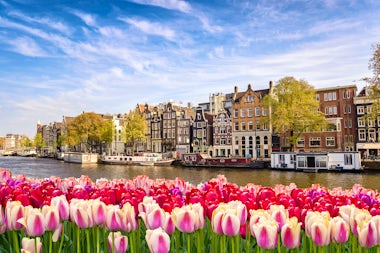
Originally a dam in the river Amstel, Amsterdam today is the capital and largest city of the Netherlands, as engineered dams, sea gates, and the 19-mile dyke walling out the Zuider Zee prevent this low-lying country from being reclaimed by the North Sea. Interestingly, the 17th century canals of Amsterdam located in the heart of the city have been added to the UNESCO World Heritage List. The main tourist attractions are undoubtedly the famous Museums such as the Rijksmuseum, the Van Gogh Museum, and the Stedelijk Museum. Read more about Amsterdam, Netherlands
|
| 8 |
Saturday, October 2, 2027 |
Amsterdam, Netherlands |
|
Disembark |
Originally a dam in the river Amstel, Amsterdam today is the capital and largest city of the Netherlands, as engineered dams, sea gates, and the 19-mile dyke walling out the Zuider Zee prevent this low-lying country from being reclaimed by the North Sea. Interestingly, the 17th century canals of Amsterdam located in the heart of the city have been added to the UNESCO World Heritage List. The main tourist attractions are undoubtedly the famous Museums such as the Rijksmuseum, the Van Gogh Museum, and the Stedelijk Museum. Read more about Amsterdam, Netherlands
|